
They do not show you the propane torches in dairy adverts.
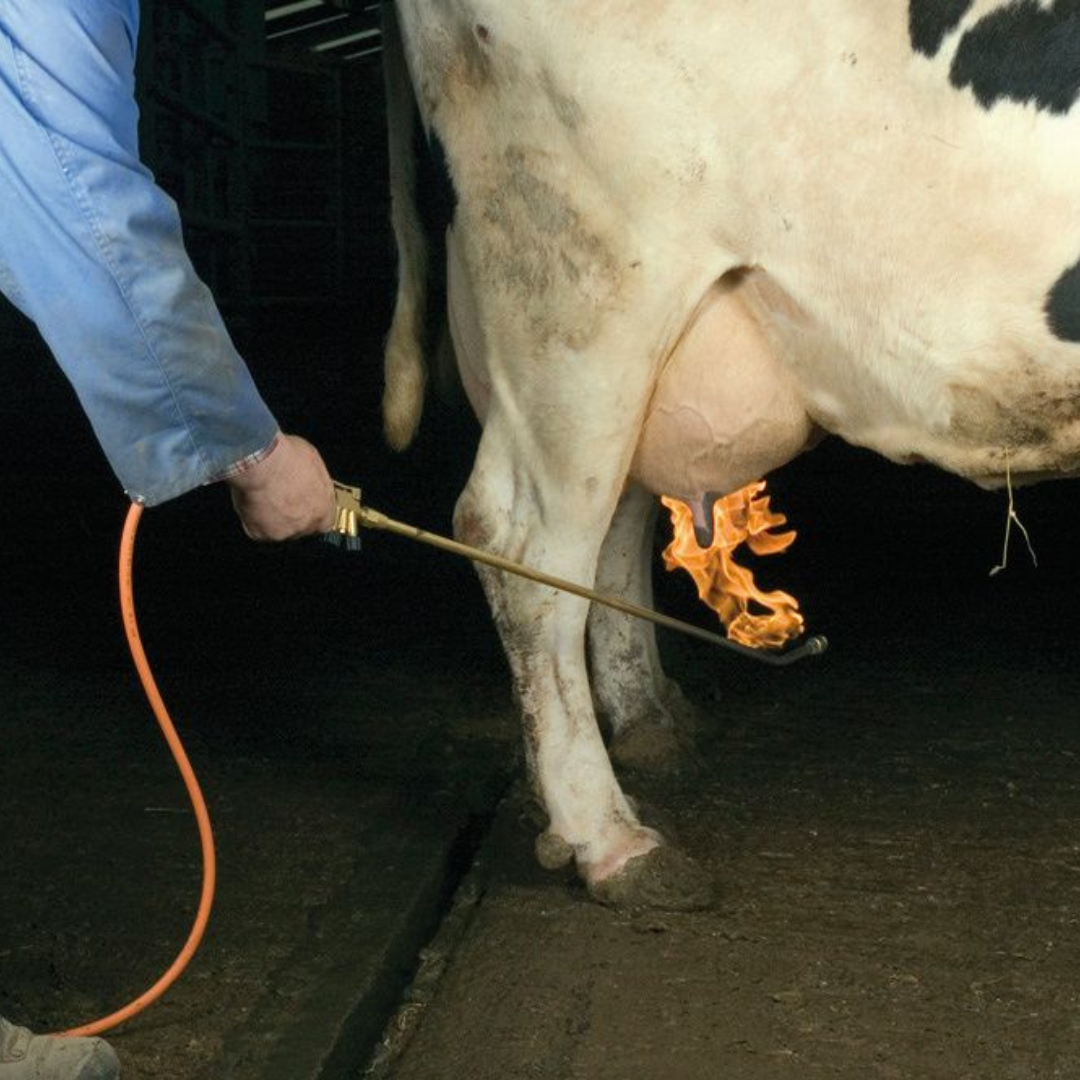
Yet on some dairy farms, workers briefly pass a flame under a cow’s udder to remove hair. The industry often calls it udder singeing or flame clipping. The stated reason is hygiene: less hair can mean less dirt stuck near the teats, which can support lower bacterial contamination and lower somatic cell counts (SCC).
That is the claim. Here is what the practice is, why it exists, what evidence supports the hygiene argument, and where welfare concerns fit.
What is udder singeing?
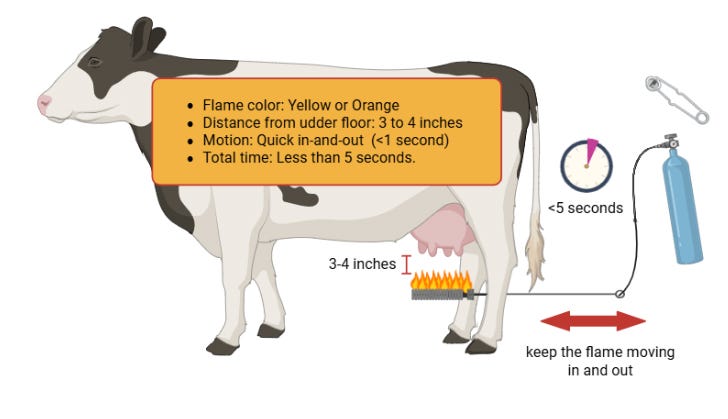
Udder singeing is a form of hair removal. A worker uses a handheld propane wand/torch and makes fast, sweeping passes near the udder and sometimes the area around the rear quarters. The goal is to singe off hair, not to heat the skin.
On farms that use it routinely, the pass can take seconds per cow. It may be repeated through the year as hair regrows (often more during colder seasons when coats thicken).
Supporters describe it as quick and quiet compared to electric clippers. Critics describe it as an unnecessary risk applied to one of the most sensitive parts of a cow’s body.
Both perspectives matter, because the key issue is not only intention. It is what can happen in real barns, with rushed labour, varied training, and animals that move.
Why farms do it: the hygiene and cost argument
The hygiene logic is simple:
- Udder hair can trap manure, mud, bedding, and moisture.
- That material can carry bacteria.
- During milking, bacteria near the teat end can increase the risk of:
- milk contamination (quality and food safety concerns)
- mastitis (udder infection, a major welfare and economic problem)
This connects directly to farm economics. Mastitis treatment costs money. Discarded milk costs money. High SCC can trigger penalties or lost contracts.
Many dairy extension resources discuss udder hair removal as one part of a broader “clean cow” strategy, alongside clean housing and good milking routine. For example, Penn State Extension describes udder hair removal (including singeing) as a method to help achieve cleaner udders and better milk quality, not as a stand-alone fix.
Some equipment and automation discussions also mention singeing as an option for improving udder cleanliness and milking performance in certain systems, including robotic milking contexts. Example (industry source).
The uncomfortable question is this: is singeing being used as a carefully managed hygiene tool, or as a shortcut that distracts from the real root causes of dirty cows?
Because if stalls are wet, bedding is poor, cows are overcrowded, and manure management is weak, removing hair does not remove the source of contamination. It just changes how contamination sticks.
Does singeing reduce bacteria in milk?
There is evidence that managing udder hair (by singeing or clipping) can be associated with improved cleanliness outcomes in some settings. One example is research that looks at contamination indicators and spore levels in milk, where hair removal is considered among farm practices that may reduce contamination risk.
A 2025 paper (Journal of Dairy Science Communications) reported reduced spore levels when farms removed udder hair by singeing or clipping (abstract link on PubMed).
Important note: a single study does not “prove” the practice is always necessary or always beneficial. Outcomes depend on the whole system: housing cleanliness, pre-milking preparation, drying practices, machine maintenance, and staff consistency.
So the honest summary is:
- Cleaner udders help.
- Hair removal can contribute to cleaner udders.
- Hair removal is not a substitute for clean housing and good milking hygiene.
SCC, mastitis, and what “clean milk” really means
Somatic cell count (SCC) is often used as a proxy for udder health. Higher SCC usually signals inflammation, often from infection. Many milk buyers reward low SCC.
Mastitis is not a spreadsheet metric. It is pain, swelling, heat, abnormal milk, and sometimes fever. It can be clinical (obvious signs) or subclinical (hidden but harmful).
This matters for India too, even if torch singeing is less commonly documented in Indian public guidance. Mastitis is a major issue across dairy systems, including smallholder systems.
A systematic review and meta-analysis of Indian studies (1995 to 2014) reported a high pooled estimate for subclinical mastitis prevalence in dairy cows (often cited around the mid-40% range, depending on included studies and methods).
So when the industry says “we do this to prevent mastitis”, it is pointing at a real problem. The question is whether the chosen method reduces suffering overall, or simply protects output numbers at the cheapest cost.
Does it hurt? What welfare concerns are reasonable to raise
This is where many articles become propaganda on one side or the other.
Some farms and suppliers claim singeing is low-stress when done correctly because it is quick, quiet, and involves less physical contact than clippers. Critics argue the udder is highly sensitive, and fire near skin is an unnecessary welfare risk.
What can we say without exaggeration?
- A flame close to skin can cause burns if used poorly.
- Risk increases if the flame is held too close, too long, or if hair is dirty or damp (flare-ups).
- Cows move. They twitch. They kick. A small mistake can become an injury.
What we cannot honestly claim, without more direct modern welfare trials, is a universal statement like “it never hurts” or “it always burns skin”. There is limited recent research that directly measures pain and welfare outcomes across many farms performing singeing under real conditions.
So a truth-first welfare conclusion looks like this:
- Singeing may be done without obvious injury in some cases.
- The practice still introduces avoidable risk to a sensitive body area.
- Welfare depends heavily on training, time pressure, restraint, and cleanliness.
And beyond physical pain, there is a moral concern about normalising fire as routine husbandry. A “standard practice” can still be ethically wrong if it exists mainly to serve speed and cost.
For broader dairy hygiene guidance focused on preventing contamination and infection at the source (rather than cosmetic fixes), see this practical hygiene resource hosted by Texas A&M (originating from dairy hygiene guidance).
Why you may hear about this more in the US and Europe than in India
Udder singeing appears more often in public discussion in high-throughput, industrial, or highly automated contexts, where speed and consistency are heavily valued.
In India, many dairy producers operate in smaller units with different labour patterns and different infrastructure. That does not prove singeing never happens. It suggests it is less widely documented in mainstream Indian extension material.
What is global is the pressure. Low SCC. High yield. Tight margins. Those forces push farms towards “efficiency tools”, and sometimes the animal becomes the surface where that efficiency is applied.
Cleaner milk without the flame: practical alternatives that target root causes
If the goal is fewer bacteria near teats, there are options that reduce risk without introducing fire.
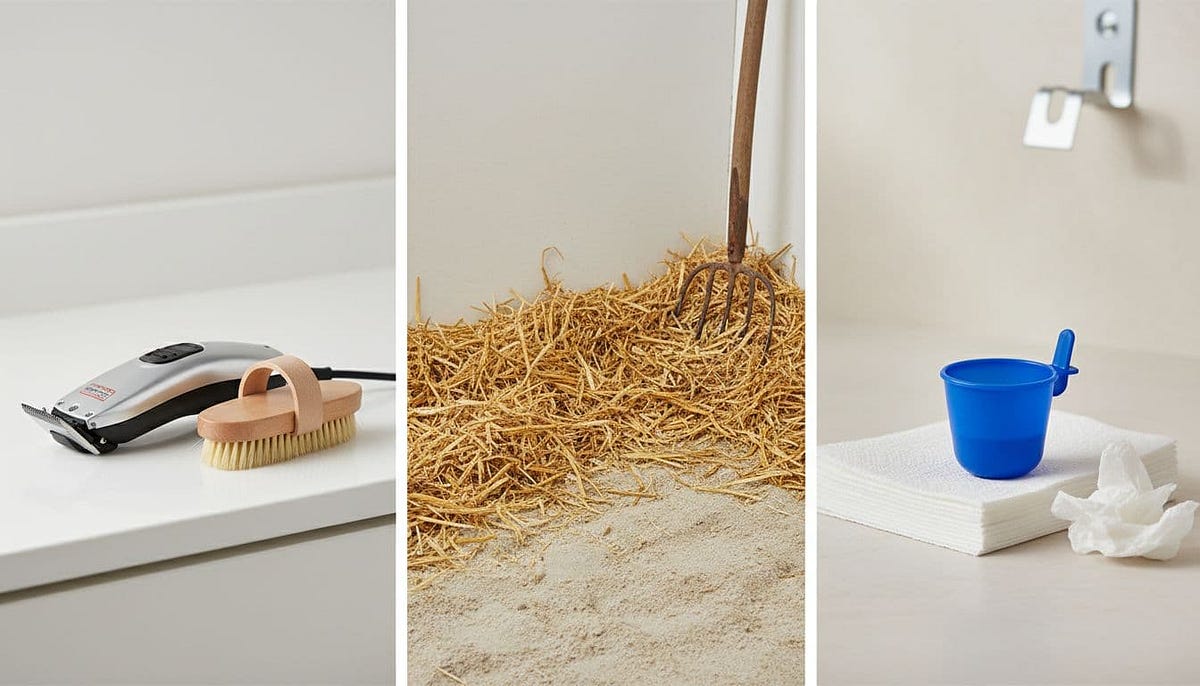
1) Clipping (non-flame hair removal)
- Pros: no burn risk, familiar method
- Cons: can take longer; clipper noise and vibration can stress some animals
2) Better housing hygiene (biggest upstream win)
- dry, clean bedding
- frequent manure removal
- ventilation to reduce moisture
- adequate space to avoid cows lying in dirty areas
3) Milking routine and teat preparation
- consistent pre-milking cleaning
- thorough drying (moisture helps bacteria travel)
- post-milking teat disinfection
- machine maintenance to prevent teat-end damage
Hair removal can support these steps, but cannot replace them.
The bottom line
Udder singeing is real. Some dairy farms do briefly burn off udder hair using a propane flame to support cleanliness and milk quality goals. There is a logic to reducing hair that traps dirt.
There is also real evidence that hair management (clipping or singeing) can be associated with better cleanliness outcomes in some contexts.
But it is not a magic hygiene fix. And it brings a welfare risk that is easy to downplay and hard to justify when better prevention exists.
If you want a simple way to think about it: A food system that respects animals should not need fire to make cleanliness feel normal.

Saket Sambhav is the founder of WriteToWin, India’s premier environmental writing competition for school students. A legal professional and DBA candidate in sustainability, he launched WriteToWin to shift generational mindsets – empowering students to make conscious choices and protect the planet. He also mentors young eco-entrepreneurs, nurturing the next wave of climate leaders.