The world treats war and climate as separate crises. They are not, and children are paying the highest price.

A baby born under drone fire does not face one crisis. That child faces two. First comes war, with its blast waves, hunger, fear, and loss. Then comes the slower violence, climate breakdown, which lingers after the cameras leave.
By 2025 and into 2026, the world was living through well over 50 active conflicts, while broader counts put armed conflicts at around 130 worldwide, the highest level seen in decades.
At the same time, researchers and watchdogs estimate that militaries produce about 5.5% of global greenhouse gas emissions. That share may be higher, because reporting is weak and many emissions stay hidden.
We still talk as if war and climate sit in separate boxes. They don’t. One feeds the other, and children pay twice.
War is not only a humanitarian crisis. It is also a climate accelerant, and children inherit both fires.
War is a climate story, even when nobody counts the smoke
Most people see war in human terms first, as they should. We see rubble, graves, and families running with plastic bags of what remains.
Yet war also belongs in any honest climate story, because armies burn huge amounts of fuel and battles wreck the systems that keep emissions in check.
The trouble is that much of this damage stays off the books. Military reporting is patchy, voluntary in key areas, or buried under national security claims.
As a result, the public sees the flames, but not the carbon ledger behind them. The gap is so large that The Military Emissions Gap exists to track what governments do, and do not, report.
The military already has a huge carbon footprint before a single missile is fired
Before a war starts, the baseline is already heavy. Jets, warships, tanks, bases, supply chains, and weapons factories all eat fuel. They run day and night, in peace and in war.
If the world’s militaries were a country, they would sit among the biggest emitters on Earth. That’s before one refinery burns, one apartment block collapses, or one city loses power.
Once fighting starts, the damage spreads far beyond the battlefield
Then the footprint widens fast. Missiles spark fires. Oil and gas sites leak or explode. Power grids fail. Cement and steel shatter into debris, only to be rebuilt later with more carbon-heavy materials.
Current wars in Ukraine, Gaza, Sudan, and Myanmar are all adding to this bill. But the numbers remain incomplete. That matters, because when counting is weak, the damage looks smaller than it is.
How today’s conflicts lock children into tomorrow’s climate disasters
War doesn’t just heat the planet. It strips away the basic shields children need when heat, drought, flood, or disease strike. In other words, conflict turns climate danger from a bad forecast into a daily trap.
Bombed farms, broken water systems, and blacked-out hospitals make every heatwave deadlier
A heatwave is dangerous anywhere. In a bombed city, it becomes far worse. Water pumps fail. Food spoils without electricity. Hospitals lose cooling, medicine storage, and clean sanitation. Families shelter under tin, tarpaulin, or cracked concrete that traps heat like an oven.
The same pattern holds for floods and disease outbreaks. If sewage lines are broken, floodwater carries more illness. If farms are shelled or fields are abandoned, drought bites harder.
If clinics have no staff or fuel, children miss treatment for diarrhoea, fever, asthma, and malnutrition.
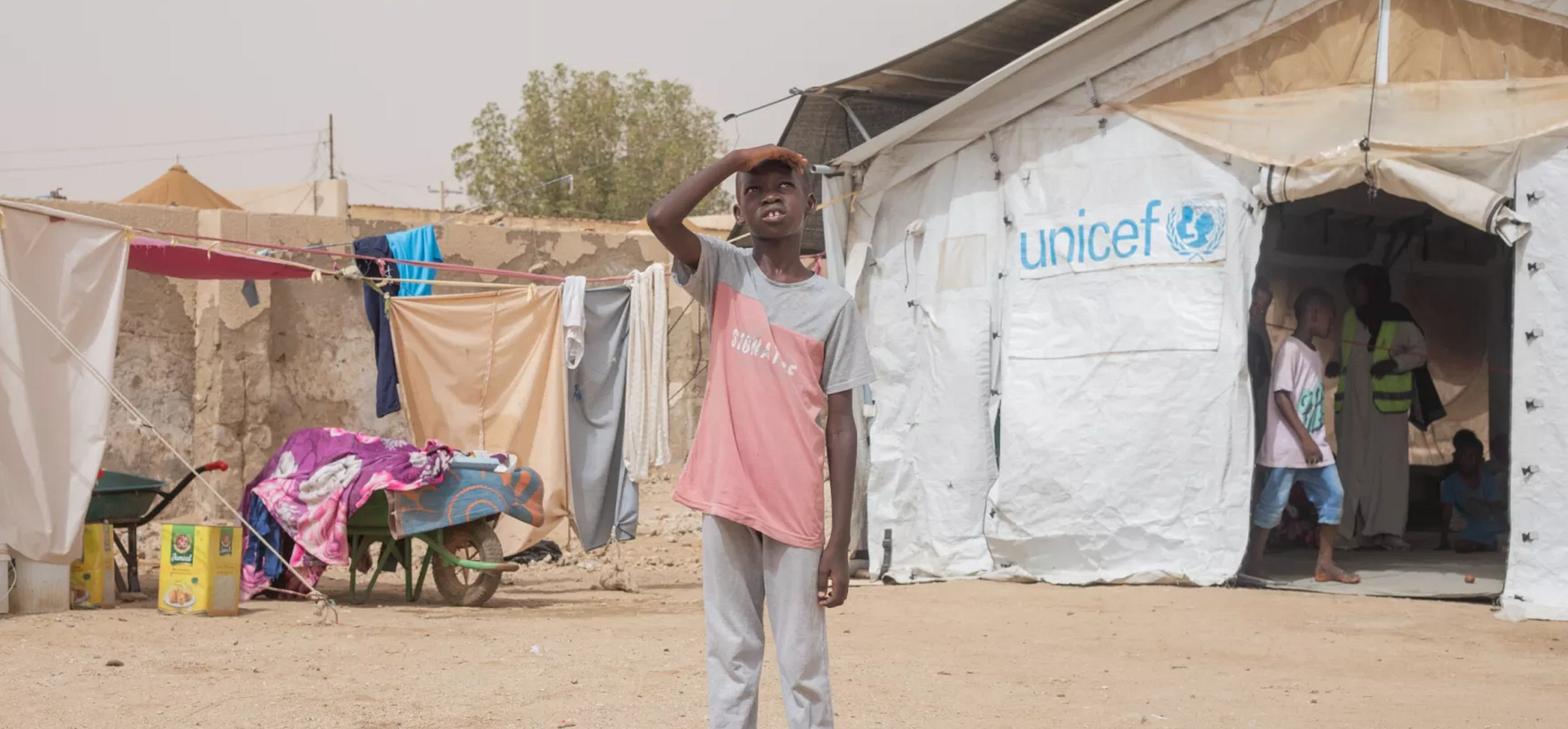
This is why war damage multiplies climate harm. It destroys the very systems that soften the blow. In Sudan, for example, UNICEF has warned about children facing both climate and conflict pressures, while humanitarian reporting shows outbreaks of cholera, measles, dengue, and hepatitis E spreading through weakened health and water systems.
Displacement turns climate risk into a permanent childhood condition
Displacement makes the danger stick. A child forced from home rarely lands in a safe, cool, well-served place. More often, families end up in camps, crowded shelters, or poor urban edges where drainage is weak, shade is scarce, and food costs more than they can pay.
Then normal childhood starts to unravel. School stops. Vaccines get missed. Sleep gets worse. A local support network vanishes. Even clean air can disappear if a camp sits near dust, diesel generators, or open burning.
For millions, climate risk becomes a permanent condition, not a one-off shock. In Sudan alone, CRIN’s briefing on children, conflict and climate notes that 16 million children need humanitarian assistance.
That is not a side issue. That is a whole generation growing up on a fault line.
The cost does not end when the shooting stops
Even when guns fall silent, war keeps billing the future. The damage sits in debris piles, shattered roads, poisoned land, and budgets drained for years. Children then grow up inside that unpaid debt.
Rebuilding shattered cities can lock in years of extra emissions
Reconstruction sounds hopeful, and often it is. But it is also carbon-heavy. Clearing rubble takes machines and transport. Rebuilding homes, schools, hospitals, bridges, and water lines takes cement, steel, glass, bricks, and more fuel.
So war creates a brutal loop. First comes destruction. Next comes emissions-heavy rebuilding. Then, because climate shocks worsen, those same rebuilt places may face heat, flood, or fire with fewer public funds left to prepare.
That long tail is not theory. Research on post-2001 US wars has linked them to more than 1.2 billion tonnes of CO2 over time.
The smoke from war does not end when the last headline fades.
Money spent on war is money NOT spent protecting children from climate breakdown
Budgets tell the moral story. When military spending rises, emissions tend to rise too. New research in Nature on military spending and climate targets shows that higher global military expenditure can push up CO2 emission intensity and make climate goals harder to meet.
Every currency note pushed into weapons is a note not spent on clean power, flood protection, stronger hospitals, cooler homes, safer food systems, and early warning plans.
This matters everywhere, from India to Iowa, from Khartoum to Kyiv.
Children cannot drink fighter jets. They cannot shelter under missile systems. They cannot breathe defence budgets.
Children will carry the longest sentence
The plain truth is hard to sit with. Conflict is not separate from the climate crisis. It helps drive it, hides part of it, and then leaves children to absorb the aftershocks for decades.
So the minimum response is clear. Militaries and war emissions need honest reporting.
Military expansion needs far sharper public scrutiny. And our moral frame must widen, because peace, climate safety, and child welfare belong in the same sentence.
If we keep bombing the present, we are also burning the future.
Children should not have to survive both the war we make and the climate we worsen

Saket Sambhav is the founder of WriteToWin, India’s premier environmental writing competition for school students. A legal professional and DBA candidate in sustainability, he launched WriteToWin to shift generational mindsets – empowering students to make conscious choices and protect the planet. He also mentors young eco-entrepreneurs, nurturing the next wave of climate leaders.