A good listicle is like a street food stall with a queue. People stop because it looks simple, quick, and worth their time. A bad one is like a loud billboard that promises a feast and serves air.
If you write online, you’ve seen both. The format is everywhere because it works, but it also gets abused. And when it’s abused, readers feel it. They click, skim, and leave with that familiar sense of being nudged, not helped.
This guide breaks down what a listicle is, why it still performs well in late 2025, and how to write one with dignity, clarity, and a spine.
What is a listicle (and why people keep reading them)
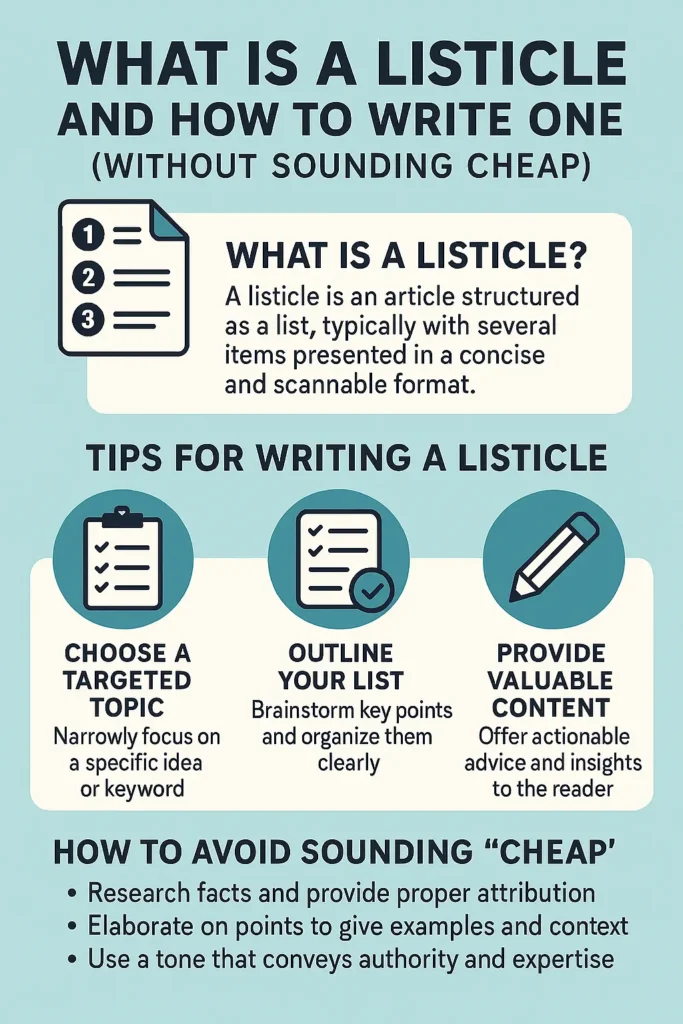
A listicle is an article built around a list, usually numbered, where each item delivers a clear idea, tip, example, or recommendation. Think: “7 ways to cut food waste” or “12 signs your city is choking on traffic”.
It’s popular for one plain reason: it respects time. A reader can scan headlines, pick what they need, and still feel they got the full picture.
Listicles also fit how search works right now. Google often pulls structured answers into featured snippets, and AI tools tend to quote neat, self-contained points. That’s not magic, it’s formatting and clarity.
If you want a straightforward definition and a few real-world examples, Shopify’s guide is a useful reference: How To Write a Listicle.
When a listicle is the wrong tool
Not every truth fits into a tidy row of bullets.
A listicle is the wrong choice when:
You need deep cause and effect: If you’re explaining why heatwaves are worsening in South Asia, a list can help, but it can’t carry the whole story.
Your points depend on sequence: Some topics need a narrative arc. If order matters, a step-by-step guide or essay might serve better.
You’re tempted to pad the count: If you only have five strong points, don’t force twelve. Readers can smell filler like stale oil.
A listicle should make things simpler, not thinner.
The anatomy of a strong listicle
A listicle isn’t “just a list”. It’s a structure with ethics. The reader gives you attention, you owe them coherence.
1) A title that sets a clear promise
Strong listicle titles do two things: name the topic and signal the benefit.
Bad: “Amazing Tips You Need Today”
Better: “10 small ways to cut home energy use (that actually stick)”
Keep it honest. Don’t bait people into the wrong room.
2) A short, punchy lead
Your introduction should tell the reader what the list covers, who it’s for, and what they’ll walk away with. Two or three small paragraphs are enough.
3) A logical organising idea
A list without logic is a junk drawer.
Pick one backbone:
- By priority (most important first)
- By theme (cost, health, community, policy)
- By timeline (today, this week, this month)
- By difficulty (easy wins to harder shifts)
4) Items that earn their place
Each point needs one job. Make it specific, then support it with a short explanation, a detail, or a quick example.
If you want a practical breakdown of what makes listicles perform well and how to shape them, BuzzSumo has a solid overview: How to write listicles.
How to write a listicle step by step (with a mini example)
You don’t write a listicle by hunting for a number. You write it by answering a real need, then choosing a format that helps people act.
Step 1: Start with one reader problem
Write down the problem in plain speech.
Example: “I want to talk about air pollution, but people switch off.”
Now convert that into a listicle angle: “Ways to spot air pollution risks in daily life” or “Habits that quietly make city air worse”.
Step 2: Choose a number you can defend
Pick a count you can fill with strong points. Eight good items beat twenty weak ones every time.
A simple check: if you can’t explain each point in 60 to 120 words, it’s not ready.
Step 3: Outline first, then write
Draft your item headings before you write the body. This helps you avoid repeats.
Keep headings parallel. If one starts with a verb, the rest should too.
Example headings for a sustainability listicle:
- Measure your biggest energy drain
- Switch one daily commute a week
- Eat leftovers like it’s normal
- Buy less, repair more
- Use your vote beyond elections
Notice how each one is an action, not a vague idea.
Step 4: Make each item concrete
Here’s what one item might look like:
Eat leftovers like it’s normal: Food waste isn’t just guilt, it’s methane, money, and missed respect for labour. Plan one “leftovers meal” day each week. Put it on the calendar, not in your hopes.
Short, clear, and grounded.
Step 5: Close with a landing, not a fade-out
Wrap up with two or three sentences that restate the point of the list, and tell the reader what to do next. A listicle should end like a door opening, not a cliff edge.
For more tips on keeping listicles tight and readable, Compose.ly has a useful guide: How to Write a Compelling Listicle.
SEO and trust: make listicles that don’t feel like clickbait
SEO isn’t the enemy. Manipulation is.
If you want your listicle to rank and still feel human:
Use the main keyword naturally: If the topic is “what is a listicle”, say it early, then use close variants like “listicle format” and “how to write a listicle.
Write for skimmers and stayers: Make headings informative, then add real substance under each.
Add proof where it matters: Link out to credible sources when you make claims, especially in health, climate, finance, or law. Links are also a quiet signal: you’re not hiding in your own echo.
Don’t fake urgency: “Before it’s too late” belongs in disaster warnings, not blog titles.
Editing checklist before you publish
A listicle is easy to draft and easy to ruin. Edit like you’re protecting a reader from noise.
Use this quick checklist:
Scan test: Do the headings tell the full story on their own?
No repeats: Are any two points saying the same thing in different clothes?
No padded intros: Does each item get to the point quickly?
Proof of value: Did you add examples, numbers, or steps where helpful?
Tone check: Does it sound like a person who cares, not a machine that wants clicks?
Conclusion: write listicles like you’re accountable to the reader
A listicle can be light, or it can carry weight. It can sell nonsense, or it can help someone change a habit, challenge a system, or see a pattern they missed.
Treat the format as a public service: clear headings, honest claims, and points that earn attention. Your reader’s time is a real resource, and wasting it is a quiet form of theft.
Write the listicle you’d want to read on a crowded train, on low battery, with a mind full of bigger things.

Saket Sambhav is the founder of WriteToWin, India’s premier environmental writing competition for school students. A legal professional and DBA candidate in sustainability, he launched WriteToWin to shift generational mindsets – empowering students to make conscious choices and protect the planet. He also mentors young eco-entrepreneurs, nurturing the next wave of climate leaders.