Want your articles to get read, shared, and bookmarked? This guide gives you clear steps to improve article writing skills, fix common mistakes, and write for real people first.
You will learn how to research fast, plan your angle, craft catchy titles, use E-E-A-T without fluff, and smooth your flow with strong transitions. Think simple plans and repeatable checklists.
Plan, write, title, edit. Use the checklists as you go.
🧠 Is Your Article People-First?
Tick the boxes below to self-assess your draft:
If you ticked 4 or more, your article is reader-ready. If not - read this article and polish!
Research your article topic like a pro and plan a clear angle
- Define audience and intent in one sentence. Example: A parent wants a quick guide to help a teen write a school article.
- Gap scan: skim the top 5 to 10 results. Note what they cover, what they miss, and the questions you keep seeing. This shows you where to add more value.
- Fast research stack:
- Search operators: site:, intitle:, filetype:pdf
- Google Scholar for studies
- News pages for fresh data
- Public datasets for facts
- Forums or communities for real voice
- One short interview or quote
- Keep a source log with author, date, link, and a one-line takeaway
For practical quick wins, this guide on 15 tips for writing articles reinforces structure and tone, and this Coursera overview on ways to improve your writing skills covers grammar and practice habits that will tighten your drafts.
- Turn notes into a simple outline:
- List 3 to 5 big questions your reader has.
- Map each question to one H2.
- Add 2 to 4 H3s with steps, examples, or tips.
- Add E-E-A-T early:
- Experience: share first-hand examples, screenshots, or photos.
- Expertise: add a credentials line or past results.
- Authoritativeness: cite primary sources and respected sites.
- Trust: add dates, clear claims, and clean links. Label opinions as opinions.
- Planning template:
- Problem
- Why it matters
- What to do
- Proof
- Next steps
Short example outline:
- H2: What beginner writers miss about research
- H3: Define the reader in one line
- H3: Build a source log
- H2: Write people-first drafts
- H3: Hook, promise, preview
- H3: Active voice swaps
- H2: Title and headings
- H3: What makes a title work
- H3: Title formulas with examples
- H2: Edit and avoid mistakes
- H3: Common mistakes with fixes
- H3: Layered editing checklist
Define the reader and search intent in one line
Use a one-sentence brief: Who is the reader, what do they want, and what is the win.
Example: A New freelancer wants to write engaging articles that rank and convert. Intent: learn and fix a problem.
Intent types: learn, compare, buy, fix a problem. This line guides your scope, tone, and level of detail.
Build a reliable research stack and source log
Use a simple order for trust:
- Primary research (interviews, your tests, your data)
- Official publications and primary sources
- Academic or reputable reports
- Well-known industry sites
- Community threads for the voice of the customer
Source log template:
- Link:
- Author:
- Date:
- Quote or stat:
- How I will use it:
- E-E-A-T notes:
Favour recent sources. Save exact quotes to avoid errors. This personal article on how to write better articles that people read also shows how experience adds clarity and trust.
Turn rough notes into a tight outline
Build a question-first outline:
- Use H2s for the main reader questions.
- Add H3s for steps, examples, or mistakes to avoid.
- Write one-line promises under each H2, so you stay focused.
- Add a flow note at the end of each section to signal the next idea.
- Keep sections balanced, around the same length, so the final piece feels even.
Example:
- H2: How to research fast
- Promise: You will build a source log in 10 minutes.
- Flow note: Next, we draft in plain language.
Bake in E-E-A-T from the start
- Experience: add first-hand notes, screenshots, or a mini case study.
- Expertise: include your role, years, or results in a short bio.
- Authoritativeness: link to primary or official sources when you cite.
- Trust: state the last updated date, check names and numbers, and avoid claims you cannot support.
Add a small author box with credentials and a date at the end. If you lack direct experience, borrow it with quotes, short interviews, and case studies.
Write people-first drafts that readers finish
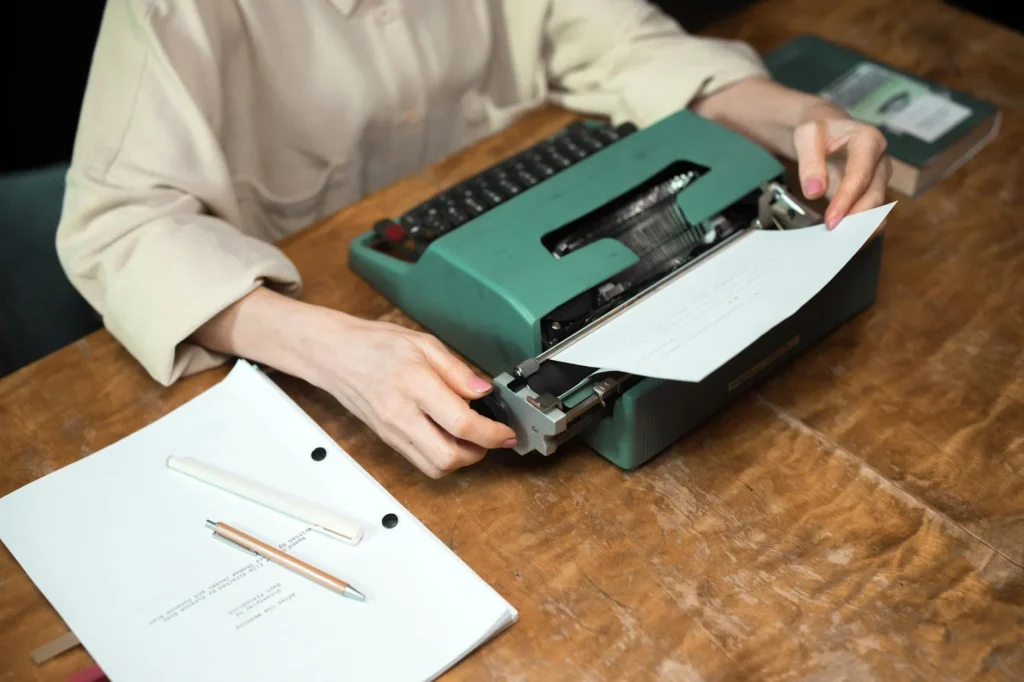
Keep sentences short, use active voice, and guide like a friendly coach. Open with a hook, set a simple promise, and give a quick preview. Break up text with subheads and bullets. Use reader language from your research. End each section with a clear takeaway.
Open with a strong hook, clear promise, and quick preview
Three openers that work:
- Common mistake with a fix: Many articles bury the point, move your main idea to the first two lines.
- Short story: A client doubled time on page after we cut a slow intro and added subheads.
- Surprising stat with a source: After a quick polish, writers often cut 15 percent of words and increase clarity.
State the promise in plain words: By the end, you will know how to plan, write, title, and edit a better article.
Use plain language and active voice
Quick swaps:
- Use get over obtain.
- Use help over facilitate.
- Use start over initiate.
Fix passive voice:
- Passive: The report was written by Sam.
- Active: Sam wrote the report.
Cut 20 percent. Remove filler like very, actually, really, and sort of. Short, clear sentences help readers finish.
Transition words that boost flow and clarity
Use one transition at the start of a sentence to guide the reader.
- Add: also, and, plus, besides
- Sequence: first, next, then, finally
- Cause and effect: because, so, therefore, as a result
- Compare: likewise, similarly, in the same way
- Contrast: but, however, yet, on the other hand
- Examples: for example, for instance, such as
- Clarify: in short, in other words, that is
- Emphasis: above all, key point, most important
- Conclusion: in sum, overall, to wrap up
Make it engaging with proof, story, and steps
Use a simple pattern: claim, proof, example, action.
- Claim: Short intros keep readers.
- Proof: Our tests showed bounce rate dropped after we cut first paragraphs.
- Example: Replace a 120-word warm-up with a 25-word promise and a bullet list.
- Action: Cut two lines from each paragraph, then add a bold takeaway line.
Prefer concrete details. Instead of saying add data, write: Add one stat in the first screen, link the source, and explain it in one line.
Write a catchy, honest title and strong headings
Balance curiosity, clarity, and keywords. Match search intent, keep it accurate, and promise a clear benefit. Aim for 55 to 65 characters when possible. Front-load the main keyword and the benefit. Use H2s and H3s as signposts for skimmers.
What makes a title clickworthy without clickbait
Traits that work:
- Specific outcome
- Exact audience
- Strong verb
- Number or timeframe when useful
- Honest scope
- Consistent tone with the article
Quick test: Would a reader feel satisfied after reading, and does the title match the content? If not, fix it.
Proven title formulas with examples
Templates you can plug in:
- How to achieve X even if Y
- X mistakes to avoid for Y
- The simple checklist for X
- X vs Y, which is better for Z
- The step-by-step guide to X
- X power words to improve Y today
- How X works and how to do it right
- What is X, and how to use it for Y
Examples for this topic:
- How to improve article writing skills even if you are new
- 9 common article writing mistakes to avoid in 2025
- The simple checklist for a people-first article
- People-first content vs keyword-first content, which is better for readers
- The step-by-step guide to E-E-A-T for writers
- 15 transition words to improve flow today
Use keywords naturally and match intent
Pick one primary keyword and two to four related phrases. Place the main term near the start of the title, in the H1, opening, a subhead, and the meta description. Keep language natural. Match intent types like how to, mistakes, checklist, or examples.
Test and refine your title after you publish
Run quick tests:
- Share two versions on social and see which gets more clicks.
- Ask five readers which title is clearer and why.
- Watch email click rate.
If the piece ranks, update the title and meta to reflect the top query you see. Keep changes honest and aligned with the content.
Avoid common mistakes and edit for clarity, trust, and SEO
Edit in calm layers. Target people-first content that is easy to read and easy to trust. Then polish for search so the right readers can find it.
Common article writing mistakes to avoid
- Weak or missing thesis: Write a one-line claim in the intro.
- Long warm-up intro: Move the main point to the top and cut the rest.
- Walls of text: Add subheads and bullets.
- Passive voice: Switch to active verbs.
- Vague words: Replace with concrete, short terms.
- No sources: Add links to primary or trusted sources.
- Keyword stuffing: Use natural phrasing and synonyms.
- Sloppy facts: Verify names, dates, and numbers.
- No clear next step: End with one action or link to a guide.
Edit in layers with a simple checklist
Four passes:
- Content and structure: Does each section answer a reader question and flow?
- Clarity: Shorten sentences, swap jargon, add transitions.
- Proof and E-E-A-T: Verify facts, add sources, add author info and a last updated date.
- SEO polish: Title tag, meta description, slug, subheads, internal links, image alt text.
Finish with a read-aloud pass to catch rough spots.
Fact-check and cite like a pro
Verify names, numbers, dates, and quotes. Link to primary sources when you can. Note the publication date and author. Add a short line of context so the stat matters. Keep a simple reference list at the end if the article is long.
On-page SEO that supports people-first content
Quick wins:
- Clear slug with the main term
- Front-loaded title tag
- Helpful meta description with a benefit
- One main H1
- Logical H2 and H3 structure
- Internal links to useful pages
- Alt text that describes the image
- Compressed images for speed
Helpful content comes first, SEO helps people find it.
Conclusion
Better articles follow a simple loop: plan with research and E-E-A-T, write a people-first draft with strong transitions, craft an honest catchy title, then edit in layers to fix mistakes. Try a weekly routine: pick a topic, outline in 20 minutes, draft in 60 minutes, edit in layers, publish, and improve the title after feedback. Your quick challenge: update one old article using this outline and add a stronger hook. Keep writing for humans first, then refine for search. Thanks for reading, now go ship your next draft.
Know a writer chasing impact? Share this guide with them.

Saket Sambhav is the founder of WriteToWin, India’s premier environmental writing competition for school students. A legal professional and DBA candidate in sustainability, he launched WriteToWin to shift generational mindsets – empowering students to make conscious choices and protect the planet. He also mentors young eco-entrepreneurs, nurturing the next wave of climate leaders.