
There was a time when I loved balconies...
Not because they were luxurious or aesthetically remarkable, but because they opened into life. They opened into movement, leaves trembling in the wind, birds resting on branches, evening air drifting quietly through trees, and the comforting reassurance that the world outside was still alive. For the first eleven years of my life, I lived in Noida, in one of the greenest sectors of the city.
My house was surrounded by parks, dense trees, and roads softened by shade. After that, I moved to Chandigarh for four and a half years-a city whose very design seemed to understand something modern urban spaces have begun forgetting: human beings were never meant to live separated from nature. My house there was almost surrounded by forest. Even the silence in Chandigarh felt organic. The wind did not merely pass through the city; it breathed through it.
At that age, I never consciously reflected upon these things. I never thought that greenery could influence emotional life so deeply. Nature, when it exists abundantly around us, becomes invisible. Like oxygen, we notice it most only when it begins disappearing.
Yet when I look back now, I realise something profound: I was happier there. I liked going outside. I loved evening walks. I loved standing near windows and balconies. I loved looking outside my house. There was a softness to life, an openness, an emotional ease that I never paused to question because I assumed it was simply part of my personality.
Then I moved to Baroda…
And slowly, without realising it at first, something inside me began to change.
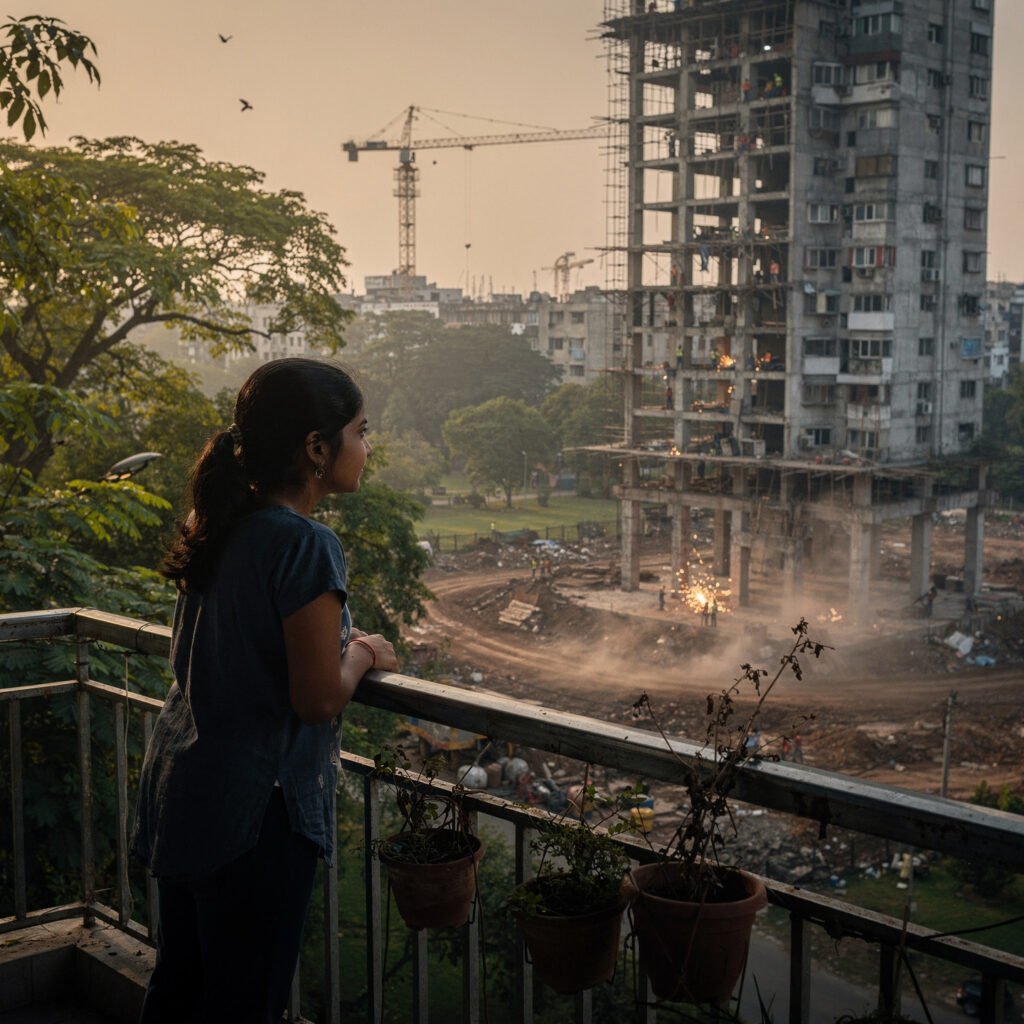
I currently live in Vemali , Baroda. Every morning, before I fully wake up, I hear drilling. Hammering. Construction. Metal crashing against concrete. The sound is not occasional; it is incessant. A constant mechanical violence that enters the nervous system before the day has even begun. Beside my apartment, a new building is emerging from the earth. On the roads around my locality, pits remain dug endlessly. Everywhere there are construction sites, unfinished structures, cement, dust, debris, and exposed soil. It feels as though the entire area exists in a permanent state of excavation.
But the most disturbing part is not merely the sound. It is the absence.
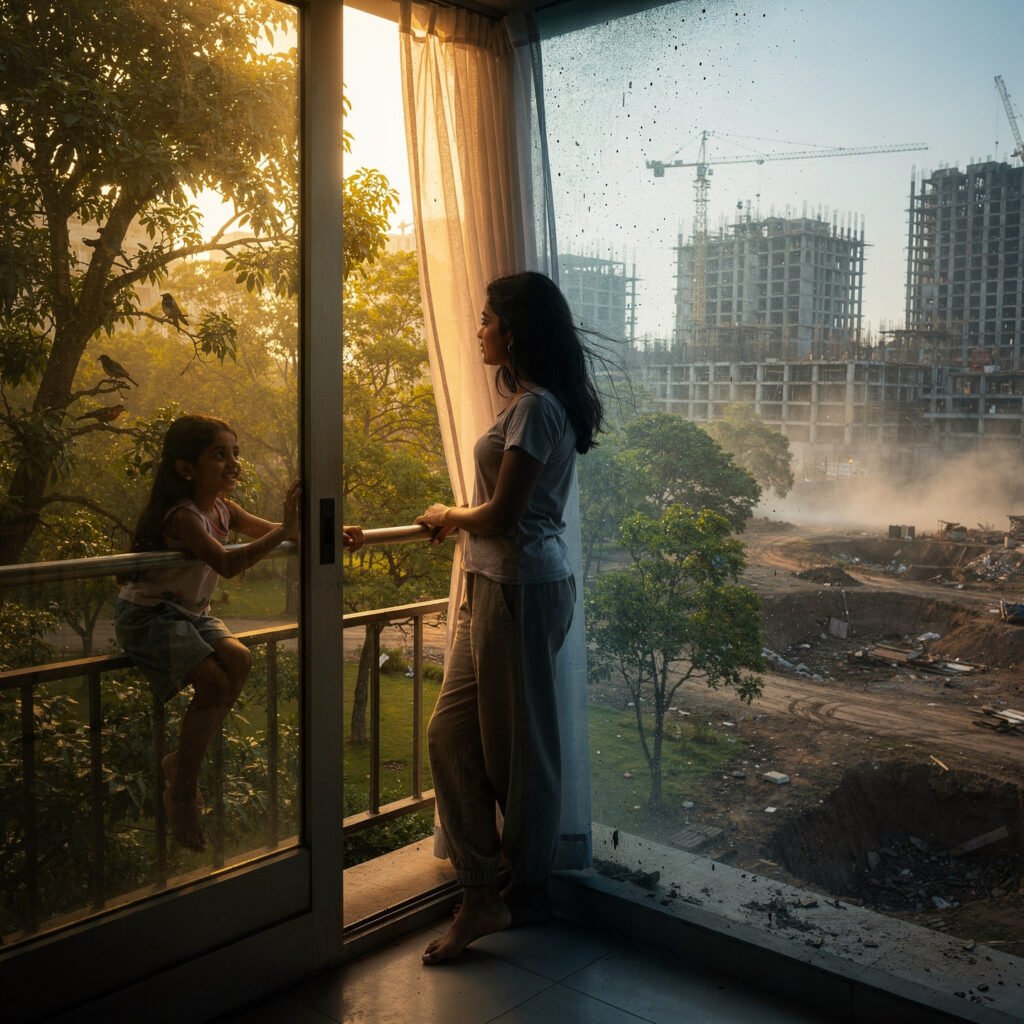
When I look outside now, I barely see trees. Everywhere there are buildings and more buildings-rising walls of concrete blocking sunlight, obstructing air, swallowing open space. Earlier, balconies connected me to the outside world. Now, I no longer even enjoy standing near my window. I have gradually stopped going for walks. I barely step outside unless necessary. Somewhere along the way, I became strangely home-ridden. Restless. Irritable. Anxious. I have never felt so emotionally exhausted in my life.
And what pains me most is the realisation that this locality was once green.
A local resident once told me that years ago this entire area was covered with dense vegetation and trees. Sometimes I find myself grieving a landscape I never even personally witnessed. I look outside and try to imagine what this place must have once looked like before concrete overtook it. Before every empty patch of land became a future construction site. Before nature became something constantly displaced in the name of expansion.
And that is when I began to realise something modern society rarely acknowledges: environmental destruction is not only happening outside us. It is happening inside us.
We are taught to think about trees scientifically. Trees provide oxygen. Trees absorb carbon dioxide. Trees maintain ecological balance. Trees prevent soil erosion. All of this is true. But somewhere in reducing nature to ecological utility alone, we have forgotten another truth-perhaps the more intimate truth.
Human beings are emotionally intertwined with nature.
Not metaphorically. Literally.
The biophilia hypothesis proposed by Edward O. Wilson suggests that human beings possess an innate affinity toward nature because for thousands of years human evolution occurred within natural environments.
Our minds were not formed amidst concrete towers, construction noise, polluted skylines, and endless excavation. They evolved amidst rivers, forests, open landscapes, changing skies, birdsong, shade, and living ecosystems.
Nature is not external decoration to human civilisation; it is part of the environment in which human consciousness itself evolved.
Perhaps that is why the disappearance of greenery affects people in ways they often struggle to articulate.
Environmental psychologists Rachel Kaplan and Stephen Kaplan, through the Attention Restoration Theory, demonstrated that natural environments restore mental and emotional balance in ways dense urban environments often fail to do. Studies repeatedly show that people living near parks, trees, and water bodies experience lower anxiety, reduced stress, stronger emotional regulation, and greater life satisfaction. Even brief visual exposure to greenery reduces psychological fatigue. Hospital patients recovering with views of trees heal faster than those facing concrete walls. Children raised around green spaces display stronger emotional resilience later in life.
The implications of this are enormous.
What if the emotional exhaustion of modern urban life is not merely personal weakness or poor stress management? What if part of our anxiety is ecological?
The more I reflected on my own experience, the more I realised that deforestation is not simply nature losing a part of itself. It is human beings losing a part of themselves.
Somewhere between disappearing trees and expanding concrete, many of us have quietly lost our enthusiasm for life. We have become overstimulated yet emotionally undernourished. We live in cities louder than ever before, yet internally emptier. We speak constantly about ambition, growth, productivity, and development while our nervous systems slowly collapse under environments never designed for emotional well-being.
Research on noise pollution now shows that chronic exposure to construction noise elevates stress hormones, increases anxiety, disrupts sleep cycles, and contributes to emotional instability. The “cacophony” of urbanisation is not merely irritating-it physiologically alters the human body and mind. And perhaps that explains why I no longer enjoy going outside, why I no longer stand in balconies, why I cannot even bear to look at the view outside my own home.
Environmental philosopher Glenn Albrecht coined the term solastalgia to describe the emotional distress caused when one’s home environment changes negatively while one is still living there. Unlike nostalgia, where one misses a place after leaving it, solastalgia is the pain of remaining in a place while watching it deteriorate around you.
That word describes exactly what I feel.
But the deepest realisation came not from my own apartment alone, but from what existed beside it.
Near my society lies a basti where dozens of families live in fragile homes with irregular electricity and limited resources. Beside that basti is a neglected pond surrounded by bushes and overgrown vegetation. During the night, the area becomes almost completely dark. Children play near the dirty water while their parents leave during the day searching for work. On one side stand gated societies with security guards, uninterrupted electricity, and rising real estate values. On the other side exists environmental vulnerability in its rawest form.
This contrast revealed another painful truth: environmental destruction is never experienced equally.
For the privileged, ecological decline may first appear as discomfort, ugliness, stress, or emotional exhaustion. For poorer communities, it becomes danger itself-polluted water, unsafe infrastructure, unbearable heat, lack of sanitation, and ecological insecurity.
This is why deforestation and environmental degradation are not merely environmental issues. They are psychological, social, and moral issues.
And yet despite everything, I do not believe humanity is powerless before this destruction. In fact, some of the greatest hope I have encountered has come not from grand speeches by world leaders, but from ordinary people who simply cared enough to act. Across India, countless communities, innovators, students, and young entrepreneurs are quietly proving that environmental responsibility is not an impossible ideal but a living practice. The Chipko Movement showed villagers embracing trees with their own bodies to protect forests from being cut down, while the Bishnoi community sacrificed generations in defense of wildlife and ecology long before environmentalism became fashionable.
During the Khejarli massacre, hundreds gave their lives protecting trees from destruction. In Rajasthan, Rajendra Singh helped drought-stricken villages revive rivers and groundwater systems through collective water conservation efforts, proving that even dying landscapes can return to life when communities refuse to surrender them. In Piplantri village, trees are planted for every girl child born, transforming ecological restoration into a cultural act of love and continuity. More recently, citizens protesting in the Aravalli Range and environmental activists opposing illegal forest clearances in Hyderabad reminded the country that resistance still matters.
Alongside these grassroots movements, a new generation of educated youth is beginning to reimagine environmental responsibility through science and innovation. Startups such as Banyan Nation and Daily Dump are developing sustainable waste-management systems, while young engineers across the country are designing technologies to clean polluted lakes without harming aquatic life, create biodegradable alternatives to plastic, and build affordable clean-energy solutions for both rural and urban India.
In Tamil Nadu, even a young girl’s invention of a solar-powered iron box became symbolic of something much larger: the extraordinary power of ordinary initiative. These people may not possess endless wealth or global influence, yet they possess something far more transformative-the willingness to care. And perhaps that is the truth we, the educated urban generation, must confront most honestly.
We constantly call ourselves the future of India, but are we truly concerned about the future we ourselves will inhabit? Because if communities with fewer resources, less privilege, and little institutional power could protect forests, revive rivers, conserve water, and rebuild ecological balance through unity and persistence, then imagine what could happen if thousands of educated individuals, scientists, architects, entrepreneurs, students, and local communities stood together with the same emotional commitment toward the earth. Perhaps the real crisis today is not the absence of solutions, but the absence of collective urgency.
Ultimately, the smallest actions still matter-protecting existing trees instead of casually removing them, creating balcony gardens, preserving lakes and parks, supporting environmental initiatives, reducing unnecessary waste, conserving water, and most importantly, paying attention. Ecological restoration begins first not with policy, but with emotional responsibility.
Because at its deepest level, this essay is not about trees alone.
It is about what happens to human beings when they lose meaningful contact with nature.
Somewhere beneath disappearing forests, blocked sunlight, polluted ponds, endless construction, and expanding concrete lies another quieter tragedy-the gradual erosion of human emotional life itself.
Perhaps the true tragedy of deforestation is not only that the earth becomes poorer.
Perhaps it is that we become poorer with it.
Not financially.
Emotionally.
Psychologically.
Spiritually.
And perhaps saving nature today is no longer merely an environmental responsibility.
Perhaps it is an act of preserving our own humanity.