I care about the planet, people, and power. I also care about words. The hard part is that my writing life often happens between meetings, night shifts, or doomscrolling climate news. My drafts end up full of heart, but also full of waffle.
Strong ideas get buried under long paragraphs and soft phrases. A sharp call to action drowns somewhere in the middle. The message that could move someone to act just sits there, muffled.
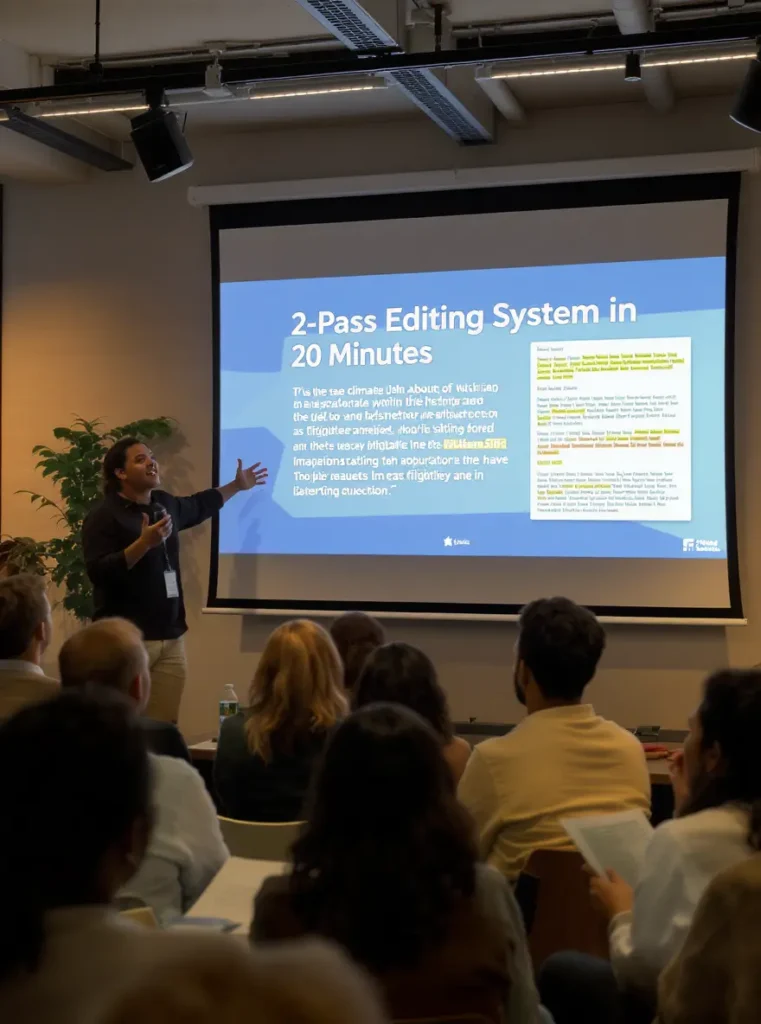
That is where a simple two-pass editing system saves me. One fast pass for the big picture, then one pass for sentence-level polish. Around 20 minutes in total. No drama, no myth of the genius writer, just a repeatable process.
By the end of this guide, you will be able to tighten your own articles, blog posts, essays, campaign pages, or social explainers on climate and justice, without feeling rushed or overwhelmed.
Why Fast, Clear Editing Matters for Change Makers
When I write about climate, racism, or workers’ rights, I am not just sharing thoughts. I am asking people to care, decide, and act. Muddy writing is like dirty glass on a protest banner. The message is there, but it is hard to see.
Clear, tight writing is a tool for real-world impact. Social justice editors talk about this a lot, and I have found pieces like Social Justice Editors Chime in on Tips for Activist-Writers helpful for grounding that idea in practice.
Why Fast, Clear Editing Matters for Change Makers
When I write about climate, racism, or workers’ rights, I am not just sharing thoughts. I am asking people to care, decide, and act. Muddy writing is like dirty glass on a protest banner. The message is there, but it is hard to see.
Clear, tight writing is a tool for real-world impact. Social justice editors talk about this a lot, and I have found pieces like Social Justice Editors Chime in on Tips for Activist-Writers helpful for grounding that idea in practice.
How messy drafts can hide strong ideas
I often start with a rant. Four versions of the same point. Quotes from three reports. A heartfelt story that only lands in paragraph five.
Picture a climate explainer about heatwaves. The first three paragraphs describe my feelings, the history of summer holidays, and a side note about ice-cream vans. The clear point that “heatwaves are deadlier in poorer neighbourhoods” shows up in paragraph four.
Most readers never reach it.
Long rambles, repeated points, academic phrases, and vague calls to “raise awareness” all make people stop reading, even if they care. The ideas are not weak. They are just buried.
Why speed matters when I write about climate and justice
Campaigners, students, and volunteers live on borrowed time. News cycles jump. Climate impacts hit the feed, then vanish under the next headline. If I edit for hours, I may miss the moment.
A simple 20-minute edit lets me hit publish while the topic is still fresh. It is fast enough for a TikTok caption, a Substack post, or a briefing for a local group, without giving up on care or accuracy. Editors who work with fast online content, such as the team behind Quick Online Editing Tips for the Fast-Paced Digital Environment, know how much speed matters.
The mindset shift: from "perfect" to "clear enough to act"
Perfection is a trap. When I chase it, I stall. When I focus on “clear enough to act”, the work moves.
My aim is not to sound clever. My aim is to be honest, kind, and useful. A repeatable two-pass process protects me from both extremes: the rushed hot take and the never-ending rewrite. It is kinder to my nervous system and more effective for the causes I care about.
Before I Start: Set Up a 20 Minute Edit That Actually Works
Before I touch the draft, I set myself up so the edit feels doable, not like a test.
Step 1: Clarify the one goal of my article
I write one plain sentence:
“I want a busy friend to understand why fast fashion matters and try one new habit.”
Or:
“I want a student to feel confident talking about climate justice in their seminar.”
This sentence becomes my compass in both passes. Anything that does not serve that goal is easy to cut or move.
Step 2: Take a short break so I can read with fresh eyes
Even five minutes away helps. I stretch, drink water, or stare at a tree. That tiny reset makes problems in the draft jump out, instead of blurring into the background.
For people who already feel burnt out, this pause is not a luxury. It is how we protect our mental health while still doing public work.
Step 3: Set a timer and choose my tools
I set a 20-minute timer; 10 minutes per pass. I pick simple tools: a printed copy and a pen, or a clean text editor with no notifications.
Sometimes I let an AI checker or editing tool highlight repeated words, similar to suggestions in How To Self-Edit in 3 Easy Steps. But I do not hand my judgment to a bot. The voice, facts, and ethics stay mine.
Pass One: Fix the Big Picture in 10 Minutes
The first pass is not about commas. It is about the skeleton of the piece.
Read like a tired friend who cares but is busy.
I imagine a friend who cares about climate justice but has 10 minutes before their shift. I skim my article as that friend.
I notice where my eyes slide away, where a paragraph feels dense, or where I think “get to the point”. Reading out loud, even in a whisper, shows me which sentences are heavy or tangled.
Check the message: Can I sum up the article in one clean sentence?
After skimming, I try to write one simple line that sums up the article. If I cannot, the piece is doing too much.
When that happens, I either cut side topics or split the draft into two pieces. I also pull the main point closer to the top so no one has to dig for it.
Cut the fluff: remove repeats, side quests, and softening phrases
I look for three main types of fluff:
- Side quests that drift away from the goal
- Repeated points in slightly different words
- Softening words that blur the message
For example:
- Before: “I really think we should maybe try to cut emissions quite quickly.”
- After: “We need to cut emissions quickly.”
Or:
- Before: “In my opinion, fast fashion might be quite harmful for workers and the planet.”
- After: “Fast fashion harms workers and the planet.”
The point is the same; the punch is not.
Fix the flow: make each part lead clearly to the next
I check that each paragraph links to the next. Simple bridges help:
- “So what does this mean for our town?”
- “Next, I want to look at who is most affected.”
If a section feels out of place, I move it or give it a clear subheading. I want a skim-reader to follow the arc without effort.
Tighten the call to action so readers know what to do next
I end pass one at the bottom. I ask: “If I were tired, would I know what to do now?”
Good calls to action are specific and light:
- “Sign this local petition.”
- “Share this guide with one friend.”
- “Pick one plant-based meal this week.”
If I have five different asks, I cut them down. Action should feel possible, not like homework.
Pass Two: Polish Every Paragraph in Another 10 Minutes
Now I zoom in on the sentences.
Shorten long sentences so anyone can follow along
If a sentence has more than one comma, I check if it can split.
- Before: “Climate justice is a complex issue, and while it may seem abstract, it shapes who gets flooded, who can cool their home, and who is heard in public debates.”
- After: “Climate justice can seem abstract. In real life, it shapes who gets flooded, who can cool their home, and who is heard in public debates.”
Shorter lines help readers with different language backgrounds or attention needs stay with me.
Swap heavy jargon for words my younger self would understand
I picture my 13-year-old self reading the piece. If they would frown at a word, I swap it.
Jargon word | Plainer swap |
Mitigation | Cutting emissions |
Adaptation | Coping with climate impacts |
Stakeholders | People involved |
Intersectionality | How different injustices link |
Guides like Communicating climate justice with young adults in Europe back this up; plain language helps more people care and act.
Check rhythm: read key lines aloud and smooth the bumps
I read the intro, bold claims, and call to action out loud. If I trip, the sentence changes.
Stiff: “We must urgently accelerate collective action to address the climate crisis.”
Natural: “We need to move together, and we need to move fast.”
Spoken rhythm is a good test. If it sounds human in my mouth, it will feel human on the screen.
Spot common errors with a quick personal checklist
Instead of hunting for every rule, I keep a short checklist of mistakes I often make:
- Missing full stops
- Random capital letters
- Name spellings
- UK spelling for colour, organise, centre
At the end of pass two, I run through this list once. It keeps things clean without turning writing into a grammar exam.
Give the piece a values check: does it match my ethics and care?
Last, I check the piece against my values:
- Am I fair to the people I talk about?
- Do I avoid shaming readers?
- Have I respected facts and sources?
- Does my call to action invite, not pressure?
For me, fast editing only works if it stays tied to justice, care, and truth.
Putting the Two-Pass System Into Daily Practice
This system works best when it is a habit, not a heroic act.
A simple 20-minute editing checklist I can reuse
My at-a-glance list looks like this:
- Write a sentence goal.
- Take a 5-minute break.
- Set a 20-minute timer.
- Pass one, big picture: skim, cut fluff, fix flow, sharpen call to action.
- Pass two, polish: shorten sentences, swap jargon, read key lines aloud, run my error checklist, do a values check.
How to adjust the system for longer or shorter pieces
For a tweet or a short caption, I blend both passes into a single 3-minute skim and tweak.
For a long report or essay, I still keep the order: big picture first, detail second. I might spend 30 minutes on pass one, then 30 on pass two, or even add a third pass for fact checks.
The shape stays the same, only the timing changes.
Staying kind to myself while I learn to edit like a pro
Messy first drafts are not a failure. They are proof that I showed up.
Editing is a skill, not a talent test. When I treat it as part of my activism or study routine, not as self-punishment, I last longer in the work. Clean, honest words are one way I look after both my cause and my own nervous system.
Conclusion
A simple two-pass system can tighten almost any article in about 20 minutes, without trashing my confidence. I set up the session, do a big picture pass, then a polish pass with a quick values check, and my writing is sharper and kinder.
Try it on your next climate, justice, or ethics piece, even if it is just a short post. With a small, repeatable routine, your clarity becomes part of your activism. Clear words move people. Your voice deserves that chance.

Saket Sambhav is the founder of WriteToWin, India’s premier environmental writing competition for school students. A legal professional and DBA candidate in sustainability, he launched WriteToWin to shift generational mindsets – empowering students to make conscious choices and protect the planet. He also mentors young eco-entrepreneurs, nurturing the next wave of climate leaders.