You care about the climate, justice, power, and how it all fits together. You want to write about it. Maybe you want to reach your friends, your community, or that one person who still says “I am sure it will be fine”.
But the blank page feels loud. You are short on time, your brain is tired, and the topic feels too big.
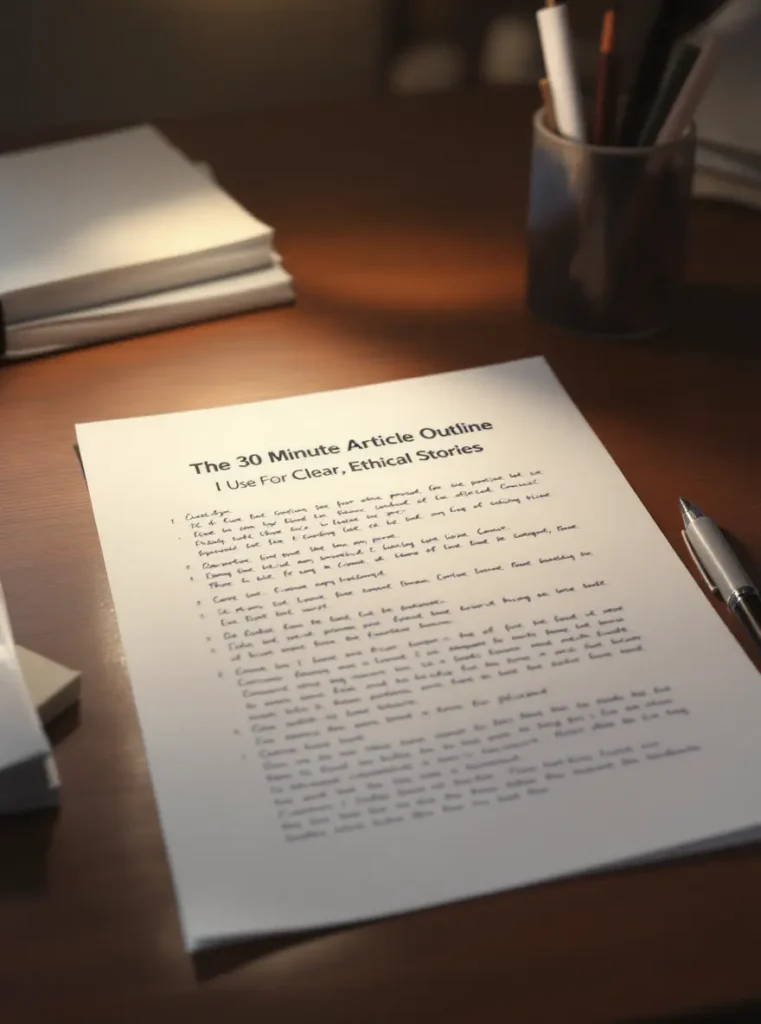
This is where a simple 30-minute article outline saves me. In half an hour, I can sketch a clear, honest path for any topic, from climate anxiety to bike lanes, and still respect complexity and care.
In this guide, I will walk through the mindset and the exact steps. The aim is less stress, faster drafts, and stories that stay kind, sharp, and ethical.
Why I Swear By a 30-Minute Article Outline Before Writing Anything
When I write about climate and justice, I am always juggling burnout, fear, and the risk of going shallow or sensational.
A short outline acts like a guard rail. It protects my focus, and it protects my values.
Outlining turns messy ideas into a clear path for the reader
Big topics feel like a tangled drawer. You know everything is in there, but you keep pulling out the wrong thing.
An outline is my map. If I start with “fast fashion and climate”, I might sketch: the true cost of a £5 T‑shirt, who pays that cost, what better looks like, and three actions a student can take this month. That path helps a reader move from “overwhelmed” to “I see where I fit”.
Good climate communication examples, like the ones in these effective climate stories for nonprofits, do the same: they guide people, step by step, instead of flooding them.
A quick plan saves time, energy, and worry
Without a plan, I waste hours tweaking sentences that later get cut. I research until my tabs look like a digital hoard.
With a 30-minute outline, the heavy thinking happens once. I know my main steps, the proof I need, and where I will stop. Drafting becomes “fill in the boxes”, not “reinvent the wheel”.
For tired students, organisers, or creators, this is gold. You keep more energy for action, not just for writing about action.
Good outlines keep my writing aligned with my values
I do not want to scare people into silence or centre only my own voice. So I built an ethics check into the outline.
I ask: Am I blaming individuals for a systems problem? Whose stories am I missing? Am I leaving readers stuck in doom? Work on the ethics of climate activism reminds me that tactics matter. The same is true for our words.
That tiny pause inside the outline keeps my writing closer to my politics and my heart.
Before the Timer Starts: 3 Quick Choices That Make Any Outline Stronger
Before I even start the 30-minute clock, I make three small decisions. They keep everything sharp.
Choose one real reader I am writing for, not “everyone”
I picture one person. Maybe a 19-year-old climate organiser who feels burnt out. Maybe a tired teacher who wants to help but is scared of saying the wrong thing.
Then I write one line: “This article is for a first‑year uni student who cares about climate but feels guilty and unsure what to do.” That simple “for” line shapes my tone, examples, and how deep I go.
Pin down the core question my article will answer
Every strong piece I write answers one main question. For example: “How can I talk about climate without scaring people away?” or “Is individual action pointless in a systems crisis?”
That question often turns into my title or a key subheading. It stops the outline drifting into “everything I know about climate” and keeps it inside one honest promise.
Decide on the one shift or action I want to leave with the reader
I ask myself: when they close this tab, what do I want to be different?
It might be “feel less alone”, “know three next steps”, or “feel ready to talk to a friend”. That target shapes my last section and my call to action. It keeps the article useful, not just interesting or angry.
The 30 Minute Article Outline Template I Use For Any Topic
Once I have my reader, question, and shift, I set a 30-minute timer. I split it into four blocks.
This pattern works for climate, social justice, tech, or even a personal essay. You can see similar logic in guides like this blog post outline template from WordPress, but here it is tuned for impact stories.
Minutes 0 to 5: Draft a working title and a simple promise
I start with a rough title that names the problem and a benefit. For example: “How to explain climate change without losing hope”.
Then I write one promise line: “In this piece I will share a simple three-part way to talk about climate that feels honest and hopeful.” Both can change later. They just give the outline a clear north star.
Minutes 5 to 15: Sketch the spine of the article in 5 to 7 bullets
Next I write 5 to 7 bullets that act like a spine. Each is one short sentence, written in plain language.
For the climate talk example, my bullets might be: name the fear, share the real picture, connect to shared values, show small wins, offer next steps, invite conversation. I keep verbs strong, and avoid vague lines like “share background”.
This is my rough table of contents.
Minutes 15 to 25: Add proof, stories, and ethical checks to each bullet
Now I add 1 to 3 notes under each bullet.
I might add: one fact or data point, one short story, and one ethics check question. For “share the real picture”, I could note a core stat and a quote from a coastal community, not just another rich city voice. I ask, “Is this fair, or am I flattening people?”
Guides on how to outline an article well talk about adding evidence and examples. I add “harm checks” too, so my facts do not erase lived experience.
Minutes 25 to 30: Plan the hook and the closing call to action
Last, I plan the first and last moves.
For the hook, I choose one sharp question, picture, or tiny story that meets the reader where they are. For the close, I list 1 to 3 things they can do today, or a few reflection prompts.
I match this to the one shift I named earlier, so the piece lands where I wanted it to land.
How To Use This Outline Template With Any Topic, From Climate To Culture
The same 30 minute outline can stretch across so many themes that matter to us.
Example: Turning a climate anxiety idea into a clear article plan
Say I want to write: “How do I live my life under climate collapse without shutting down?”
My spine might be: name the feeling, explain why anxiety makes sense, show what chronic fear does to us, offer gentler expectations, share three tiny practices, and invite people to talk about it together. For a story, I might describe a morning scroll on my phone that tipped me over.
The next steps could be simple: limit doomscrolling, choose one local group, schedule one rest ritual.
Example: Using the same structure for a local justice campaign story
Now take “Why our town needs safer bike lanes and what we can do about it”.
The bullets might be: show the unsafe streets, name who is most at risk, share a local story, point to proven results elsewhere, explain what change we want, and map easy actions. Proof could include crash data and photos. Action could be a petition, a council meeting, or a community ride.
The core pattern stays the same, just the content shifts from global to street‑level.
Adapting the template for short posts, threads, or scripts
For a thread or an Instagram carousel, each main bullet can become one slide or one tweet. The hook becomes the first frame. The call to action becomes the last.
The thinking work stays the same. You just compress the words for the format you use most.
Staying Consistent: Turning This Outline Into a Weekly Creative Habit
One outline will help. A weekly habit can quietly change your whole creative life.
Set a simple 30-minute slot and protect it like a meeting
I pick one small slot that feels realistic, like Saturday late morning or a mid‑week evening. I put it in my calendar and treat it like meeting a friend.
To cut noise, I use a timer, mute my phone, or ask a friend to outline with me on a call. Shared focus helps.
Use a repeatable outline checklist so I do not start from scratch
I keep a tiny checklist in my notes app: reader, question, shift, title, spine, proof, ethics, hook, call to action.
When I sit down, I just walk through the list. Writers who aim for speed, like in this guide on how to write an article in 30 minutes, use the same trick. Routine removes drama.
Reflect gently: what felt clear, what felt stuck, what do I try next time?
After each outline, I take two minutes to notice what helped and what hurt. Did I feel calmer? Did I feel more connected to others?
I treat this as political care, not self‑attack. I want to build a writing life that feels human, not heroic.
Conclusion
A simple 30-minute outline is not about squeezing more content out of you. It is about care, clarity, and courage when the crises around us feel huge.
You choose one reader, one question, one shift. You sketch a spine, add proof and ethics, then shape a hook and a small, honest call to action. The template is flexible, and it belongs to you now.
Pick one topic that has sat in your chest this week. Set a timer, try this outline today, then share the result with one person who might need it.

Saket Sambhav is the founder of WriteToWin, India’s premier environmental writing competition for school students. A legal professional and DBA candidate in sustainability, he launched WriteToWin to shift generational mindsets – empowering students to make conscious choices and protect the planet. He also mentors young eco-entrepreneurs, nurturing the next wave of climate leaders.